Visage · Photo Sorting Model
Visage automates photo organization using computer vision techniques, categorizing images based on detected faces, simplifying the management of extensive photo collections.
AI Engineer
AI/ML
Personal / FYP
5 tech
TL;DR
“Digital photography has led to vast collections of images, creating challenges in organization, especially for professional photographers. To tackle this, we propose a Face-Aware Image Segregation tool that uses advanced computer vision techniques, like Siamese Neural Networks and FaceNet, to automatically sort images based on faces. Initial results show promising accuracy in image segregation, but the tool faces challenges with similar-looking faces and large datasets. Future enhancements will focus on improving accuracy through data augmentation and optimizing performance for larger datasets and smaller devices.”
Problem & Approach
The story of why this project existed and the shape of the solution.
Digital photography has revolutionized how we capture and store memories, leading to vast collections of images for both personal and professional use. However, this influx of digital photos presents a significant challenge: organizing and managing these extensive libraries can be cumbersome, particularly for professional photographers who may handle thousands of images daily. To address this issue, we propose a solution: a Face-Aware Image Segregation tool that automatically sorts images based on the faces of individuals captured within them. By employing advanced computer vision techniques, such as face detection and recognition, this tool aims to streamline the photo organization process, saving users valuable time and effort.
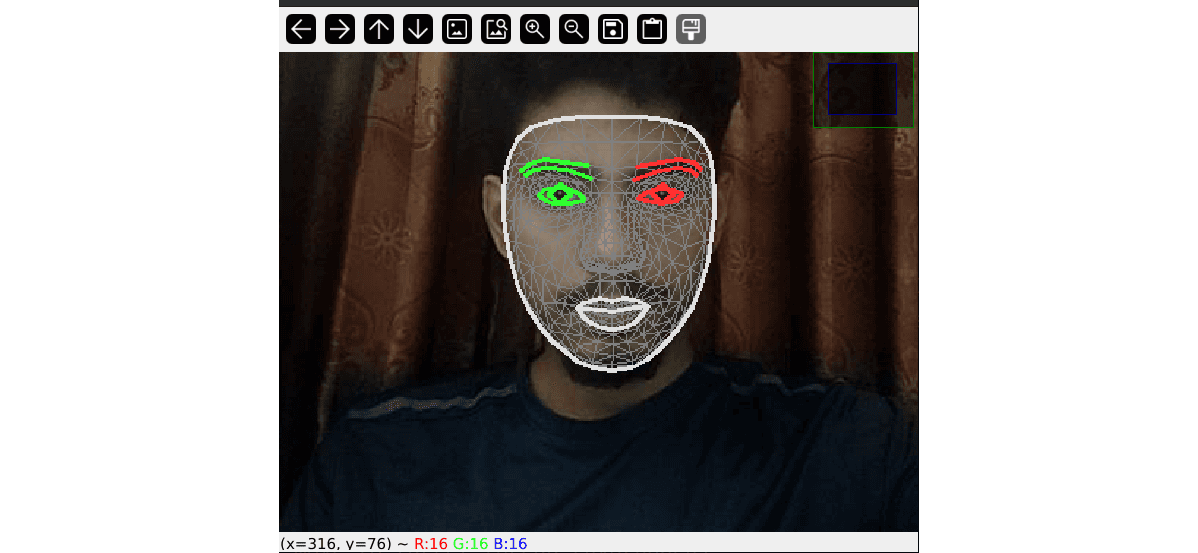
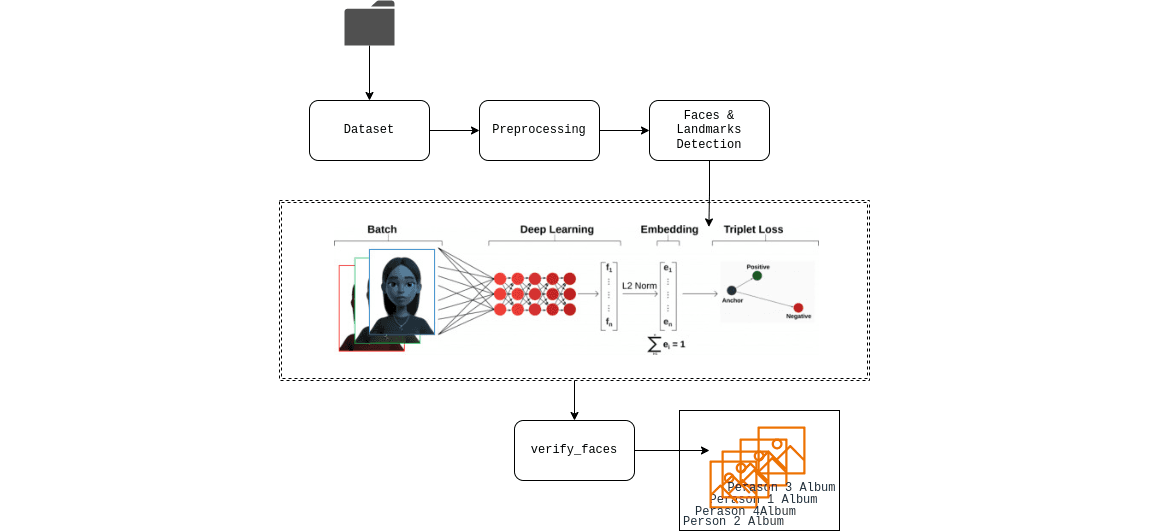
At the core of the tool are sophisticated models known as Siamese Neural Networks and FaceNet, which are specifically designed to detect and recognize faces in images. Siamese Neural Networks excel at comparing pairs of images, enabling the system to determine whether two images feature the same individual. Meanwhile, FaceNet generates unique 'embeddings' for each face, akin to a fingerprint, allowing for precise identification. The process begins with the tool detecting faces in a collection of images, after which FaceNet is employed to analyze and compare these faces, ultimately grouping images that depict the same person. This intelligent methodology facilitates efficient organization, enabling users to easily navigate their photo libraries.
Initial results from the tool have been promising, demonstrating a solid ability to effectively segregate images based on these recognitions. However, certain limitations remain. The model occasionally struggles with distinguishing between similar-looking faces, particularly in diverse lighting conditions or when the individuals are captured at varying angles. Additionally, as the size of the dataset increases, performance can decline, indicating a need for further refinement.
Looking ahead, future work will focus on enhancing the tool's accuracy through various techniques, including data augmentation, which involves artificially expanding the training dataset to improve the model's robustness. Moreover, research will be conducted to explore more efficient algorithms that can handle larger datasets while maintaining performance speed. Additionally, efforts will be made to optimize the tool for deployment on smaller devices, ensuring accessibility and usability for a wider audience. With these improvements, the Face-Aware Image Segregation tool aims to become an essential resource for photographers and anyone looking to manage their digital photo collections effectively.
Stack
AI / ML
- Python
- Media Pipe
- OpenCV
- Tensor Flow
- Deep Face
Use Cases
- ›Organizing personal photo collections for individuals by automatically sorting images based on recognized faces, making it easy to find and share memories.
- ›Automating image tagging for social media platforms, enhancing user engagement by efficiently categorizing photos and improving searchability.
- ›Facilitating event photography by grouping images of attendees, allowing photographers to quickly access and deliver photos of specific individuals.
- ›Enhancing security systems by sorting and identifying faces in surveillance footage, aiding in real-time monitoring and incident response.
Challenges & Refactors
The system sometimes incorrectly identified non-facial objects or patterns as faces. This led to inaccuracies in the recognition results.
The resolution of specific images was reduced as part of the pre-processing steps. Additionally, the training data for the model was augmented, though the extent of augmentation was limited.
Distinguishing between faces that share similar features (i.e., twins) was a significant challenge, leading to false recognition errors where different individuals were mistakenly identified as the same person.
N/A
Gallery